Third Party Intermediaries – Non-domestic Consumer Information
This page provides general information and frequently asked questions about Third Party Intermediaries (TPIs) for non-domestic energy consumers in Northern Ireland.
Always check the terms of your specific contract and seek independent advice if unsure.
What is a TPI?
TPIs are organisations or individuals that help customers compare, negotiate, arrange, or manage energy contracts.
They act as intermediaries between customers and energy suppliers.
TPIs may be described as brokers, consultants, sales agents, price comparison websites, bundled service providers, or energy advice companies.
Are TPIs regulated in Northern Ireland?
Utility Regulator does not directly regulate or license TPIs in the same way it licenses energy suppliers.
Other laws and regulations may apply to a TPI’s conduct, including trading standards, data protection, and contract law.
What types of services do TPIs offer?
A range of services, including:
Comparing energy prices and contract terms;
Negotiating deals and contracts;
Managing switching or contract renewals; and
Reviewing and validating energy bills.
How are TPIs paid?
TPIs can be paid in a variety of ways such as:
Directly: a fee charged directly to the customer (for example, a fixed fee or a transaction-based fee);
Indirectly: the supplier pays the TPI and the cost is passed on through the customer's energy charges; or
A combination of both.
Ask the TPI to provide a written explanation of their fee structure, including whether their compensation varies by supplier or product.
How do I know what a TPI is charging?
From January 2027, suppliers are required to disclose Third Party Costs (any fees, commissions or other benefits paid to a TPI in connection with your energy contract that are passed on to you by your supplier) on a customer’s terms and conditions.
Information should be displayed as both total cost and unit/day rate formats.
Contact the supplier or TPI if you need further information.
Do all TPIs work with all suppliers?
While some TPIs work with all suppliers, some work with only a limited number of suppliers or have preferred supplier arrangements.
A comparison may cover only suppliers that have a commercial relationship with the TPI or comparison service.
This can affect the range of tariffs and offers you see.
Always ask your TPI which suppliers they include in their comparisons.
What should I do if I have a problem with a TPI?
Raise concerns directly with the TPI first.
Contact the supplier named in the contract where relevant.
The Consumer Council for Northern Ireland may also be able to assist with complaints or consumer protection concerns.
If you have concerns that you have been mis-sold, you can contact Northern Ireland Trading Standards Service.
Do I have to use a TPI?
No. Non-domestic consumers can approach energy suppliers directly for quotations.
TPIs can offer an optional service that some users find convenient or cost-effective.
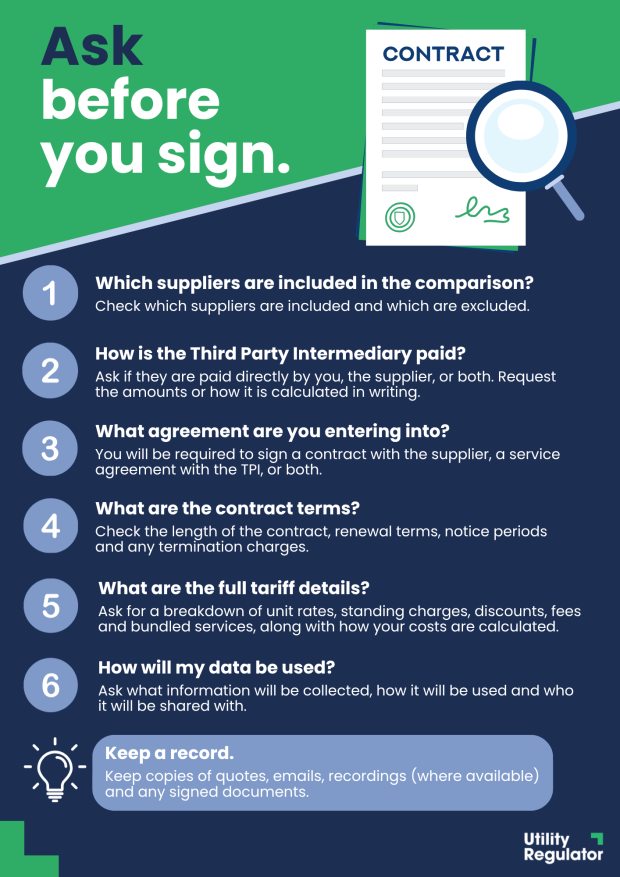
Before you sign - Key questions to ask a TPI
1. Which suppliers are included in the comparison?
Check which suppliers are included and which are excluded.
2. How is the TPI paid?
Ask if they are paid directly by you, the supplier, or both.
Request the amounts or how it is calculated in writing.
3. What agreement are you entering into?
You will be required to sign a contract with the supplier, a service agreement with the TPI, or both.
4. What are the contract terms?
Check the length of the contract, renewal terms, notice periods and any termination charges.
5. What are the full tariff details and assumptions?
Ask for a breakdown of the standing charge, unit rates, discounts, any bundled services, non-energy fees and the assumptions used to calculate your expected costs.
6. How will my data be used?
Ask what information will be collected, how it will be used and who it will be shared with.
7. Keep a record
Keep copies of quotes, emails, recordings (where available) and any signed documents.